Showing posts with label Genealogy. Show all posts

Saturday, June 1, 2013

Registration at Rice, 1939

Finally, on the third double page  of Ethel's scrapbook, registration! . On this next page we continue to find clippings dated September 12th -15th (1939). The first article, indicates Rice has yet to open it’s doors and remains in preparation for the new academic year.

Registration At Rice Begins on Thursday


1300 Students Expected as Institution Starts It's 28th year; Classes to Open Monday.

Registration for Rice Institute's twenty-eighth year will begin at 8 a.m. Thursday when approximately 1300 students will begin to enroll in the sally port on the first floor of the Administration Building.

New students in the academic course will register until 10:30 a.m., when sophomore, junior and senior academic students will begin to enroll, continuing through the afternoon. New architecture and engineering students will enroll from 8:00 a.m. until 10:30 a.m. Friday, and old engineering and architecture students will register from 10:30 a.m. to 5 p.m. Old academic students may register at any time Friday.

Jewish students will be excused from registration Thursday for the observance of the Jewish religious holiday, Rosh Hashanah Samuel G. McCann, registrar, has arranged that Jewish students register on Friday if possible, or on the following Monday, the first day of regular classes.

The traditional initiation of freshmen will start Thursday as soon as the first freshmen complete registration. Crowds gather in the sally port each year to watch sophomore men initiate the new men students. Freshmen girls will be initiated the first Friday of regular classes.

Tho construction jobs being completed for the opening of the new semester. The dining hall in the men's dormitories is being enlarged, and a new laboratory is being built onto the Chemistry Building.

The mess hall has been enlarged to almost twice its original capacity. The additional 200 feet of floor space will allow facilities for the accommodation of about 650 men. The dining hall formerly accommodated around 350 men.

The new laboratory space will be used by senior and graduate chemical engineering students for the study of unit operations. The two-story annex provides about 1600 feet of floor space. Dr. Arthur Hartsook is in complete charge of construction.

Two new scholarships are being offered for the first time this year for Rice students. The Samuel S. Ashe Scholarship endowed by Mrs. Sailie Ashe Fitch, the late Mr. Ashe's daughter, will be awarded annually to a deserving and necessitous freshman students who completes his first year's work with highest grades. The first award has been made to George W. Krog, class of 1943 of Houston.

Mr. Mabel Franklin Austen has endowed the Thomas Richard and Julia Hadley Franklin scholarship in memory of her parents. The first winner of the scholarship, to be awarded on the basis of scholarship standing and financial necessity, have not yet been announced.

Three new instructors have been appointed to the faculty this year. Dr. Edward S. Deevy, Jr. who received his Ph. D. from Yale University, has been appointed instructor in biology. Walter F. Scofield, new instructor in civil engineering, holds a B.S from the University of Kansas, where he previously held an assistant instructorship. Carl R. Wischmeyer, new engineering instructor  received his bachelor degree from Rose Polytechnic Institute and his master degree from Yale University.
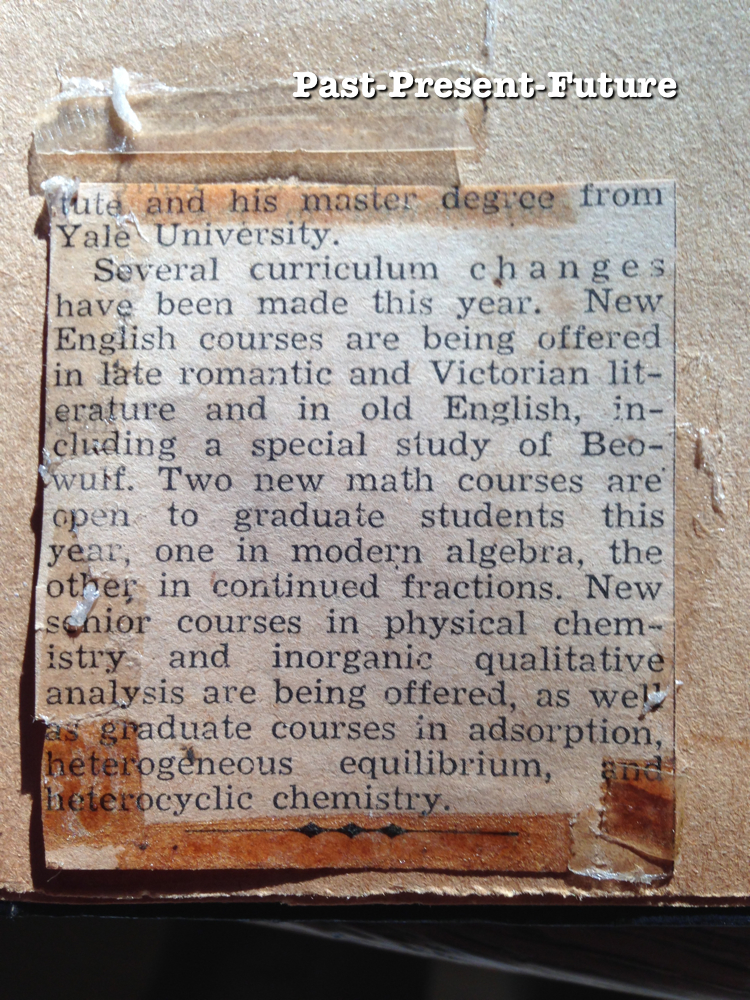
Several curriculum changes have been made this year. New English courses are being offered in the late romantic and Victorian literature and in old English, including a special study of Beowulf. Two new math courses are open to graduate students this year, one in modern algebra, the other in continued fractions. New senior courses in physical chemistry and inorganic qualitative analysis are being offered, as well as graduate course in adsorption, heterogeneous equilibrium, and heterocyclic chemistry. 

This article surprised me on initial read. I wondered why would the Houston Chronicle print such detail information about the registration schedule at Rice? I guess, without email, Rice could best reach it's student body by posting this kind of information in the paper. We do learn from this article, that Rice has been in existence for 28 years and that they were expecting 1300 students in 1939! I love the mention of the Jewish High Holidays and the exception made for the Jewish students. It's nice to know that the university was sensitive to Jewish minority. I can’t wait to hear about the Freshmen initiation ceremony!

Monday, April 1, 2013

Back to School


The next section of the scrapbook is also packed with articles. Two more pages of the Ethel's scrapbook are pack with articles spanning only four days: September 12-15. This first article is noted as Back-to-School and had not one, but two large photos. In this article, Ethel chose to celebrate Rice's advancements into modernity by examining Rice's History!

Rice Grows From Four Buildings On Prairie to Modern Institute 

September 12, 1939 back-to-school

From Ethel's Scrapbook
Photo of the Rice Institue Administration Building
"Rice Institute which begins its twenty-seventh academic session with classes Monday, started an education infant in 1912 and has grown to one of the nation’s outstanding seats of learning. 

Some 1350 students will register at Rice Institute this year, it was announced, about 400 of them freshmen.

Far Different Scene

But the students who go to Rice Institute this year to begin another year of study will meet a far different scene than did the comparative handful of students who were on deck to begin their college education when Rice first open it’s doors on September 23, 1912. 


From Ethel's Scrapbook
Photo caption: Above is pictured the Cohen
House, one of the newest building at Rice
Institue.It is used as a clubhouse for
Faculty Members
Today beautiful landscaped grounds and buildings of conforming architecture greet the new students. In 1912 Rice Institute was just four buildings on plowed prairie land with no tree or shrub in sight. 

But the 59 students who registered for the first classes saw that the foundations of a great institution had been laid, and the opening exercises gave notice to the world that nothing but the best was aspired to, that the new institution proposed to take its place among the greatest in the world. 

Colorful Story


William March Rice
Source: Wikipedia
The story of Rice Institute is a colorful-one. This beginning, with high aspirations, had been made possible by a New Englander who came to Texas a youth, became rich and left $15,000,000 of his fortune for the building and maintenance of a large educational plant for Houston Texas. That New Englander was William Marsh Rice, for whom the institute is named.

Dr. Edgar Odell Lovett, who has been president of Rice since its inception, and other heads of the college have brought to Houston many distinguished individuals as lecturers and about as many able scholars are resident members of the institute itself. It has gained steadily in national recognition both for its scholastic standing and its athletic teams.


Dr. Edgar Odell Lovett
Source: Rice Campanile Yearbook 1917
On Rice’s faculty are several internationally noted scientist, among them Dr. Harry Boyer Weiser, professor of chemistry; Dr. Asa Crawford Chandler, professor of biology, and Dr. Edgar A Altenberg assistant professor of biology.

The institute offers a liberal education in arts, as well as in sciences and engineering, for which it is particularly noted."

The first publication of the student newspaper at Rice, the Threser, was published Thursday, September 14th, in anticipation of the first day of class, Monday September 18th. All of the articles we have reviewed so far, were published prior to the first day of school. She continues to review the changes at Rice in preparation for the new academic year. I don't know about you, but I'm excited for the academic year of 1939-1940 to finally begin!

Tuesday, March 19, 2013

Page One from Ethel's Scrapbook Completed

This is the fifth and final article Ethel posted on the first page of her scrapbook. They were published in a period of 11 days, from August 31st-September 10th. And again, the Chemistry department makes news. Three of the articles feature the department where Ethel studied. We'll have to see if this is a trend, or just a coincidence.

As the country was pulling out of the great-depression which lasted from 1929-1939, Rice was investing in the sciences, particularly the Chemistry department, buying new equipment and building new labs. The new fall semester was just underway and Ethel was about to enjoy both the new Mess hall and the extra space in the Chemistry building (her major), just in time for her senior year.

"Construction is Speeded on Rice’s Campus September 11th, 1939.

Size of Mess Hall Almost Doubled and Annex to Chemistry Building is Being Completed.

---

Nearness of the new school semester is speeding the completion of two construction projects begun this summer on the Rice Institute campus.

The mess hall, between South Hall and East Hall in the men's dormitories, has been enlarged to almost double the former capacity and the chemistry building has a new annex to be used by the chemical engineering department.

The addition to the mess hall will accommodate about 300 students, bringing the total capacity of the dining room to around 650.

About 2000 square feet of floor space has been added, Albert Meyerson, contractor, said.
---
Chemistry Building Annex.

The chemistry building annex contain equipment for senior chemical engineering students. Several large pieces of apparatus bought recently by the department will be moved from the basement laboratories into the new section immediately. A 100-plate copper fractionating still, installed last winter, will be the first piece of equipment to be moved into the laboratory.

The annex will provide space to complete the demonstration of every unit process in chemical engineering, Dr. Arthur J. Hartsook, assistant professor of chemical engineering at Rice, believes. Blueprints for several new pieces of equipment to illustrate each of these processes are being made by Dr. Hartsook. He is in charge of designing and will supervise construction.
----
 Apparatus Included.

Apparatus to be placed in the annex for use in advanced courses includes a fractionating tower, a temperature control column, rotary dryer, humidifier, small steam boiler for heat material balance, and equipment to illustrate absorption and adsorption, rectification, thickening, hydraulic classification, crystallization extraction, and water softening.

The laboratory, 55 feet long and 30 feet wide, is two floors high with an iron tap-walk at the mid story level. A scientifically designed skylight will give illumination much better than that found in laboratories of most large Eastern colleges. The annex was built to alleviate the crowding in the
original laboratories when the department acquired several new pieces of apparatus last year."

When I launched this blog last week, I was unsure which newspaper the articles in the scrapbook came from, the Thresher—the Rice weekly student publication, the Houston Press or the Houston Chronicle. I have now, confirmed that they did not come from the Thresher. See if you reach the same conclusion:

From the Thresher
 Front Page Sep 14, 1939
(Click to Enlarge
See Source below)

"Chemistry Building Increased To Hold Special Apparatus


New Laboratory Offers Seniors Method For Unit Operation

Added space has been given the senior chemical engineering students, said Arthur J. Hartsook, assistant professor of chemical engineering, this summer by the construction of new wing to the north side of the Chemistry building. 

This addition was needed to place special apparatus which has been designed for "chemical engineering student operations, experience and knowledge."

Apparatus By Hartsook

The greatest part of this apparatus... (see ANNEX page four).


The continuation from this article was practically illegible and I did not attach it here. There was a separate article in this same publication about the Mess Hall expansion titled, Mess Hall Grows, Seniors Floored, which went into more detail of how it affected the student body especially which dorm. 

Surprisingly, these Thresher articles do not credit the author. In previous years, the student paper listed the reporter at the top of most articles. In 1939 they must have changed their policy, so it's unclear who wrote these matching articles. My guess is that Ethel first submitted her work to the Chronicle  and then tailored the same articles for the Rice student body. She most likely wrote both set of articles, though she was not listed as a contributor to this particular issue dated Sep 14th, 1939. It's possible another student wrote the Rice articles, we'll never know for sure. One thing is sure. The scrapbook articles are not from the Thresher! 

Source: The Thresher (Houston, Tex.), Vol. 25, No. 1, Ed. 1 Thursday, September 14, 1939, Newspaper, September 14, 1939; digital images, (http://texashistory.unt.edu/ark:/67531/metapth230458/ : accessed March 19, 2013), University of North Texas Libraries, The Portal to Texas History, http://texashistory.unt.edu; crediting Rice University: Woodson Research Center, Houston, Texas.

Saturday, March 16, 2013

Rice Opens New Courses in Chemistry

Today's article interestingly is about the Chemistry department. Ethel would have been a Junior in 1939 and a student of chemistry so this subject close to her heart. Noteworthy is the last section when she mentions which of the students were awarded fellowships. All four were men. In her unfinished memoir did describe the discrimination she felt applying for jobs in chemistry once she graduated. I wonder if she began noticing this kind of discrimination within the department as well. It will be interesting to see future articles about the chemistry department in the future. 

RICE OPENS NEW COURSES IN CHEMISTRY  9/3/1939
Revision of Senior and
Graduate Section. of Department at Institute Is Completed

Six new half-year courses and one new full-year course in chemistry have been established at Rice Institute this year in a complete revision of the senior and graduate section of the chemistry department, it was announced this week.

Half-year courses in chemistry will give short, concentrated presentations of highly specialized branches of the science. In previous years, only the longer, more generalized courses were offered. The new courses will enable advanced students to acquire more thorough grounding in chemistry, Dr. George H. Richter, assistant professor of chemistry, explained.

Special Examinations.

Also new this year are the special examinations required of candidates for master's and doctor' degrees in chemistry that have been added to the general requirements for these advanced degrees. Courses open only to students passing these examination have, furthermore, been created. The comprehensive examination to be given before October 1 on the academic year, will cover analytical, inorganic, organic and physical chemistry, as well as scientific German.

Senior students will have two new courses to choose from during the second halfyear—advanced physical chemistry and advanced inorganic qualitative analysis. Graduate students working toward an M.A. degree have open to them three new courses during the first half-year—adsorption, the theory of valence, and advanced physiological chemistry.

Heterogeneous Equilibrium.

A new course in heterogeneous equilibrium will be presented during the second half-year. Three courses will be open only to candidates for the Ph.D. degree. The most modern type of X-ray diffraction apparatus, installed this summer, will be used in chemistry 610. Heterocyclic chemistry
640 has been newly-created, and advanced inorganic chemistry completes the group. Four new men have been given fellowships in the reorganized department: Sam R. Bethea and Ervon J. Eggemann of Iowa in chemical engineering, and James Holmes of Georgia and William R Purcell of Mattoon, Ill., chemistry.

This is the second article dated September 3rd (yesterday's post, Professor A. C. Chandler, was about a Biology professor). There seems to be a science theme to day. I doubt new courses in any department at Rice would make the local newspapers today. It's interesting to think that type of information was worth of a newspaper article back then. Today, we may hear about new innovative programs at universities, but not a minor expansion of courses in a small department nor a trip to a conference by a conference by one professor.   


Remember Professor Pattie from the psychology department? The one Ethel wrote about in an article earlier the same week which I shared on the debout of this blog? Yes, the assistant professor who ran off to marry a student? Well, I was curious about him, and decided to look up the "scandalous" couple in the Rice Yearbook, the Campanile. There he sits at the bottom of the page. His bride, Miss Whatley is conspicuously missing from the Sophomore class where she reportedly belonged. I hope to find her in the future!

A page from Campanile, Rice Institute Yearbook 1938
Assistant Professor Dr. Frank A Pattie, Jr. bottom right.
(Click to Enlarge)

Ancestry.com. U.S. School Yearbooks [database on-line].
Provo, UT, USA: Ancestry.com Operations, Inc., 2010.
Original data: Various school yearbooks from across the United States.

Friday, March 15, 2013

Friday's Faces from the Past: Professor A. C. Chandler

Yesterday's launch of Ethel's Scrapbook was quite successful! The blog enjoyed 100 visitors! +Jana Last was the first to join! Thanks +Jana Last and welcome to all my new members and readers!

One of mysteries posed by Ethel's scrapbook is which publication the articles came from. By process of elimination, I believe I have narrowed down the possibilities from three to two. After studying the Thresher weekly online, on the The Portal to Texas History website, I am convince these clippings do not come from the Rice student newspaper. The Thresher articles, for the most part, list the author. My grandmother is credited to quite a few articles. Therefore, I believe the articles in the scrapbook come from her job as the Rice correspondent for the two local Houston papers, the Houston Chronicle and the Houston Press.

Today's article is titled Rice Professor Leaves To Talk at Biology Meeting. Interestingly, the article is crossed out (see image below). Several other articles throughout the scrapbook are crossed out as well. I am hoping to discover a pattern that might explain why she chose to draw a line through some of these articles. I present to you, article #2 from Ethel's scrapbook:

Rice Professor Leaves To Talk at Biology Meeting 9/3/1939


Dr. A. C. Chandler, professor of biology at Rice Institute, left Saturday for a three-week visit to New York, where he will give a paper on "Investigation of Immunity in Tape Worm Infections" before the Third International Congress of Microbiology.

The congress will be held from September 4 to 9, and will feature talks by leading biologist from many nations. Doctor Chandler is corresponding member from the section on parasitology, and is the only Texan who will be on the program. 

"In experiments I found that tape worms absorb the food from nourishment a person takes into his body, and that if there is only one tape worm its growth is successful and long lived. But if more than one are found in a person , all die except for one. 

"There might be two reasons for such results. Either the person is immune from tape worm or the other can not grow because they are crowded.
"In the experiment, I fed rats already infected with tape worms with larve worms from beetles. After observing the rats for several days an operation was performed and all but one of  the worms removed. The result was that the worm continued to grow after the others were removed. This proved that the person was not immune, but that worms could not grow because they were crowded. 

"Experiments with vaccine were not successful  A vaccine had no effect on the worm in the infected rat. Even when the vaccine was given by mouth the tape worm was not harmed. 
"Premunition was the conclusion of the experiments," Doctor Chandler said. 

Premunition means protection against infection while the patient is infected. In other words if a person is the victim of tape worm disease, no other tape worm can become dangerous until the infectious one is destroyed. 

The Summary of his address was given by the doctor before he left. 

Now what scientist today goes to a three week conference? Times have changed! This article spoke to me in several ways. My husband is a scientist who uses rats and mice in his experiments. Apart from the length of the leave, I notice a few other major differences in the evolution of scientific research since my grandmother roamed the Rice campus. For one, no one would draw conclusions on humans directly from a mouse experiment. Mice are a good model, but one can not conclude the same result in human with human trials. Secondly, I had a difficult time reaching the conclusion he drew from the experiment of surgically removing the worms. I read the paragraph several times and I'm still not sure of the conclusion. If it wasn't a direct quote from his report, I would think my grandmother might have misunderstood his experiment. Finally, I'm curious if his results hold true today (I've made a note to look this up). 

Since today is Friday Face's From the Past day, I thought I would try to find a picture the renown parasitologist. I did even better. I found a great blog post about him on the Rice's Historian's Blog by Melissa Kean. Melissa wrote about a series of coincidences which lead her to learn about professor Chandler. Ethel's article will continue the stings of serendipitous events.
Professor Chandler c1940 from Historian's Blog
One of Melissa Kean's readers, relayed a rumor that Dr. Chandler smuggled a tapeworm inside himself. Another recalled that he named a tapeworm Homer and provided the bibliography to support his claim. 
The good news is, this professor did not run off and marry a student like his colleague Dr. Frank Pattie from the psychology department (see yesterday's post).

Thursday, March 14, 2013

Welcome to Ethel's Scrapbook!

Ethel, 1936, graduating from
Sam Houston High School. She was a top
 student and at fourteen, the youngest in her grade. 
Welcome to Ethel's Scrapbook! I invite you to join me on a remarkable journey. Each day, I will post another articles from the hundreds of articles I discovered in my grandmother's scrapbook.

Ethel worked as a reporter and associate editor for the Thresher, the weekly student publication at Rice University. She also was the Rice correspondent at The Houston Press (a Scripps Howard paper) and The Houston Chronicle. Her prolific career as a young reporter is even more impressive, when you take into account that she enrolled at Rice, at the age of fourteen.

Today, as an inauguration post, I would like to start with a picture of the scrapbook, a photograph of Ethel and at her High School graduation, and the first article in the scrapbook. Do check the About page, and the scrapbook page of this blog for more information about Ethel the scrapbook. I will be posting everyday, so do check often!

Ethel's Scrapbook 1939-1940
Rice University
The inside cover has the following sticker identifying the owner of the scrapbook. From the married names on label, it's clear Ethel pasted this label much later than 1940.

This label must have been pasted after
1970 when she married Fred Alzofon.


And now...the first article from the scrapbook.

Psychology Teacher And Rice Student Wed in New Mexico 8/31/1939

A campus romance between professor and student was climaxed in Roswell, N.M. when Dr. Frank A Pattie, Jr., and Miss Billie Bess Whatley were married there, it was learned here Thursday. 

The marriage, according to an Associated Press dispatch Thursday, was performed last Thursday at St. Andrew's Episcopal church of Roswell by Rev. Frederick B. Howden, Jr., rector. It said that after a wedding trip to Mexico City, the couple will return to Houston. 


Dr. Pattie, assistant professor of psychology at Rice Institute  and Miss Whatley, who finished her sophomore year at Rice last June, became acquainted two years ago when she entered the institute as a freshman taking a pre-medical course, friends here said. 


The romance, which was not generally known on the campus, began last fall when Miss Whatley enrolled in Doctor Pattie's introductory psychology course at Rice. 


During her year's study of psychology, the young student had helped Profesor Pattie with several of his experimental research projects by serving as a subject. 


The young professor, a former instructor at Harvard University, holding degrees from Vanderbilt, Harvard and Princeton, and his bride will make their home in Houston. Doctor Pattie will continue his professorship.


Mrs. Pattie is the daughter of Mr. and Mrs.William Whatley of Roswell, N.M. 


Well, there you have it! Seems like this matrimony wasn't quite as scandalous then as it might be today. The professor was involved with a student and didn't lose his job!

Looking forward to hearing your comments!